STORE FINDER


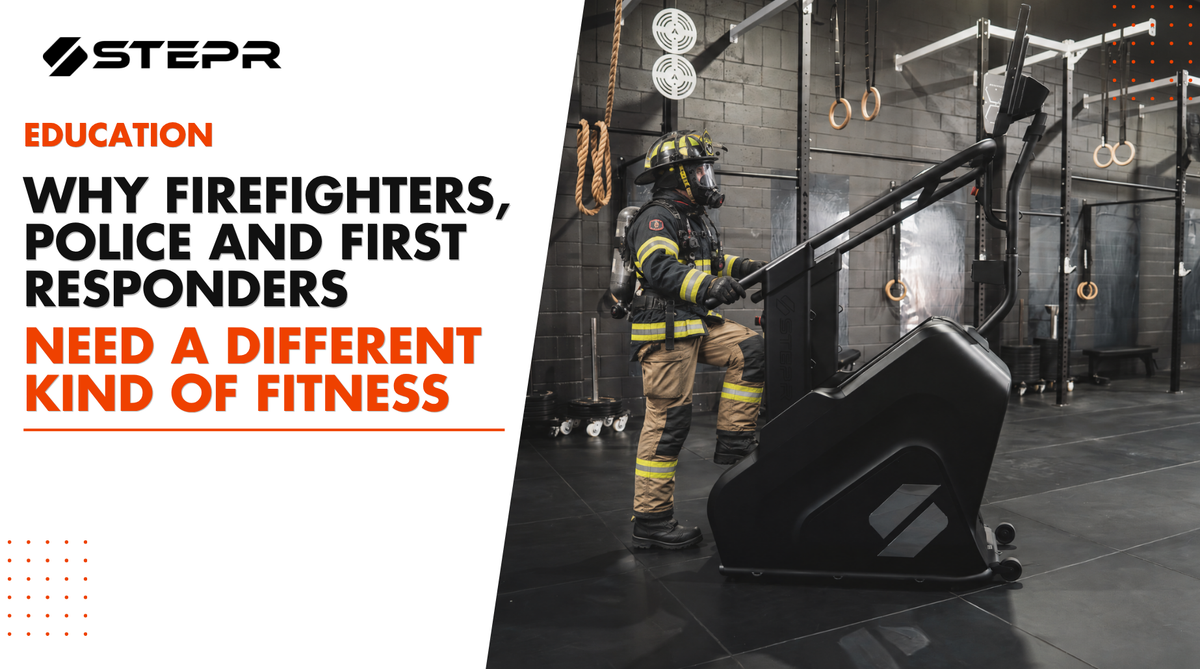
Why Firefighters, Police, and First Responders Need a Different Kind of Fitness
The statistic every first responder should know
Heart disease, not fire, not smoke, not collapsing structures, is the leading cause of on duty death for firefighters in the United States. It accounts for 45 percent of on duty fatalities, according to research published in the New England Journal of Medicine. By comparison, cardiac events account for 22 percent of on-duty police deaths and 11 percent of on-duty EMS deaths, both still well above the 15 percent average across all US occupations combined.
The same research found something more specific and more useful. The risk of a fatal cardiac event was 12 to 136 times higher during fire suppression than during routine nonemergency duties. Risk was 2.8 to 14.1 times higher during alarm response, and 2.9 to 6.6 times higher during physical training itself.
That last number matters. The training meant to prepare firefighters for the job is, without adequate baseline fitness, itself a measurable cardiac risk. The job does not wait for you to be ready. It demands maximum cardiovascular output on short notice, repeatedly, often while wearing gear that can weigh up to 29.3 kilograms, and firefighting tasks themselves require an energy expenditure of 6 to 13 metabolic equivalents, a workload most sedentary adults never approach.
First responder? Save up to 5 percent on any STEPR with GovX. Claim your discount.

Why great cardio is non negotiable in this job
For most professions, fitness is a personal choice. For firefighters and police, cardiorespiratory fitness is directly tied to whether you can physically perform the job and, in the firefighter's case, whether you survive doing it.
Research on firefighter occupational performance has found that cardiorespiratory fitness, lower body strength, and grip strength are significant predictors of completion time on the exact physical tasks the job demands, including stair climbing and hose drag under load. Firefighters with higher fitness levels consistently perform these tasks faster and with lower cardiovascular strain. Poor fitness compounds every risk factor already present: obesity affects an estimated 63 percent of firefighters, and roughly half report being physically inactive.
For police officers, the picture is different but no less serious. Data from the Buffalo Cardio Metabolic Occupational Police Stress study found officers were nearly four times more likely than the general working population to sleep less than six hours a night, and over 25 percent met criteria for metabolic syndrome, compared to 18.7 percent of the general US employed population. Depressive symptoms were reported at nearly double the rate of the general population.
Here is the finding that matters most for anyone deciding what to actually do about this. A study of Swiss police officers found that cardiorespiratory fitness moderated the relationship between occupational stress and cardiovascular risk. Officers under high job strain who maintained high fitness levels showed meaningfully lower cardiovascular risk scores than equally stressed colleagues with lower fitness. Fitness did not remove the stress of the job. It changed what that stress did to their bodies.

The specific test firefighters actually face
Firefighter physical ability testing, used across departments to certify candidates and often to requalify serving firefighters, includes a stair climb under load as a core component. The Candidate Physical Ability Test format has candidates climb stairs continuously while wearing a weighted vest simulating turnout gear and equipment.
This is not incidental. Stair climbing under load is one of the closest simulations available of what fire suppression actually demands: sustained, weighted, vertical exertion under time pressure, with your cardiovascular system pushed toward its ceiling while your muscles are also working maximally.
Training specifically for that demand, rather than general fitness that happens to include some cardio, is what separates firefighters who pass their fitness re-qualification comfortably from those who struggle every cycle. A stair climber is the only common piece of station or home gym equipment that replicates the actual movement pattern and cardiovascular demand of the test itself. Running does not simulate it. Cycling does not simulate it. Climbing does.

Why STEPR fits the specific demands of this job
It trains the exact movement your job or your test requires. For firefighters, stair climbing on a STEPR builds the same vertical loaded stepping pattern used in the CPAT and in actual fire suppression, at a resistance level you control and can progressively increase as your fitness improves.
It is low impact on a body that cannot afford more joint stress. Firefighters and police already absorb significant physical wear from gear weight, awkward loaded movement, and unpredictable physical demands on shift. Running adds repetitive impact stress on top of that. Stair climbing delivers comparable or greater cardiovascular output without it.
It fits an unpredictable schedule. Shift work, overnight rotations, and on call unpredictability make consistent gym attendance difficult for this profession specifically. A STEPR at home or in the station means a session fits into whatever window is actually available, without needing to plan around a commute or a class schedule.
No subscription, built to handle heavy daily use. Fire stations and police facilities already invest in commercial grade equipment because gear gets used hard, every day, by multiple people. STEPR's stair climbers are built to that standard, without a recurring subscription fee added to a department's equipment budget.
It directly targets the fitness factor shown to buffer occupational stress. The Swiss police research found cardiorespiratory fitness specifically, not just general activity, was the factor that reduced cardiovascular risk under high job strain. Sustained Zone 2 stair climbing sessions are one of the most direct ways to build that specific kind of fitness. Read more about how Zone 2 training can reduce occupational stress.
A realistic protocol for shift workers
Given irregular schedules, the goal is consistency within flexibility, not a rigid programme that falls apart the first time a shift changes.
Three sessions per week, 30 to 40 minutes, moderate resistance. This is the Zone 2 dose associated with improved cardiorespiratory fitness and reduced cardio metabolic risk. Fit it wherever the week allows: before a shift, after a shift, on a day off.
One session per week at higher intensity, shorter duration, simulating loaded climbing. For firefighters specifically, periodically training at a resistance and pace that challenges you the way a weighted stair climb under pressure would keeps your fitness ready for the real deal rather than just generally fit.
Recovery matters as much as the training itself. Given the sleep deficits documented in shift based first responder roles, do not stack hard sessions on the least recovered days. A stair climber's low joint impact makes it more forgiving on those days than running would be, but fatigue management still matters for both performance and cardiac safety.
The bottom line for anyone in this profession
The job will demand maximum cardiovascular output without warning. That is not a hypothetical. It is documented, repeatedly, in the data on when and how first responders actually die on duty and get injured on duty. Training specifically for that demand, with equipment that replicates it and fits into a schedule that does not resemble anyone else's, is not optional extra credit. It is preparation for the actual conditions of the work.
To thank first responders for there service, STEPR offers up to 5 percent off through GovX. It is open to law enforcement, fire and EMS, as well as current and former U.S. military and their spouses and dependents.
Here is how it works:
- Go to the STEPR GovX page and click the button.
- Verify your affiliation with GovX ID. Verification is real-time and secure, and you can log in if you already have an account.
- Copy your single use discount code and apply it at checkout.
For future purchases, log in with your GovX ID to get a new code. There is a limit of one code per day. Claim your first responder discount.

FAQ's
What is the leading cause of on duty death for firefighters?
Heart disease, not fire or smoke inhalation, causes approximately 45% of on-duty firefighter deaths in the United States, according to research published in the New England Journal of Medicine. Fire suppression specifically carries a cardiac death risk 12 to 136 times higher than routine nonemergency duties.
Why is stair climbing relevant to firefighter fitness testing?
Stair climbing under weighted load is a core component of the Candidate Physical Ability Test used across fire departments. It closely simulates the vertical, loaded exertion firefighters face during fire suppression. Research has found cardiorespiratory fitness and lower body strength directly predict stair climb completion times.
Does STEPR offer a discount for first responders?
Yes. STEPR offers first responders, including law enforcement, fire and EMS, up to 5% off through GovX. Verify with GovX ID on the STEPR GovX page, then apply your single-use code at checkout. Military and their families are eligible too.
Does fitness actually reduce occupational stress risk for police officers?
Yes. Research on Swiss police officers found that cardiorespiratory fitness moderated the relationship between occupational stress and cardiovascular risk. Officers under high job strain with high fitness levels showed meaningfully lower cardiovascular risk than equally stressed officers with lower fitness levels.
Why is a stair climber better than running for first responder fitness?
Stair climbing produces comparable cardiovascular demand to running with significantly less joint impact, which matters for a profession already absorbing physical wear from gear weight and unpredictable loaded movement. It also replicates the vertical stepping pattern used in firefighter physical ability testing, which running does not.
How should shift workers structure cardio training around irregular schedules?
Three moderate intensity sessions of 30 to 40 minutes per week is a realistic baseline, fit into whatever window a shift schedule allows. Add one higher intensity session weekly if training specifically for a loaded fitness test. Prioritise recovery on the least rested days given the documented sleep deficits in shift based first responder roles.
Explore the Full STEPR Range | Find out about VPR Technology | FREE STEPR Matchmaking Quiz | Discover More STEPR Blogs and Helpful Tips | Find A Store Near You
[Or Click the Button Below to Shop Now]

The information in this article is intended strictly for educational and informational purposes and does not constitute medical advice, diagnosis, or treatment. Always seek the guidance of a licensed physician, physical therapist, or qualified healthcare provider regarding any medical condition or before making changes to your training regimen. Individual fitness results may vary based on effort, consistency, and health history.
STEPR Blog posts
Win a $3,300+ Home Gym Set Up With Any STEPR Purchase (48hrs left)

Win an $8,000 Sisu Sauna With Any STEPR Purchase This October Only
Any STEPR purchase this month enters you into the draw for a Sisu barrel sauna worth over $8,000. Here is who this giveaway is built for and how to train and recover with both.
Every Question You Have About the STEPR TREAD Answered
Back to School: How Parents Are Reclaiming Their Fitness With the School Run
The Equipment System Cameron Hanes and Joe Rogan Actually Workout With
Joe Rogan called it "the Echo Bike, but times two." Now Cameron Hanes is training with STEPR VPR™ in a hypoxic wellness studio. Here is what they are using and why the world's most relentless athletes keep choosing it.
Why STEPR Expanded our Range and Built on What Already Works
STEPR was built on a simple premise: the most effective training modalities already exist. The question was never "what to invent from scratch" it was "how do we bring genuine innovation to what already works". Here is why the range looks the way it does.
Home Cardio Machines: Why Value Beats Price Every Time
Why the Stair Climber Is the Hybrid Athlete's Secret Weapon
STEPR Community Surpasses 500 Million Steps: A Milestone Worth Celebrating
Why the UFL Chose STEPR to Train Its Professional Athletes
The 45-7-6 Stair Climber Workout: What the Science Says