STORE FINDER


The Active Couch Potato Problem No One Wants to Talk About
You work out. You hit your zone. You track your steps, you watch your protein, and you take your health seriously...
And then you sit at a desk for eight hours.
There is an uncomfortable body of research building around what scientists call the "active couch potato" phenomenon, and if you work a desk job, the findings are worth knowing. Because the evidence is suggesting that your morning workout, your evening run, or your lunchtime session may not be doing as much to offset your sedentary hours as you might think.
What the research actually says
The active couch potato is defined precisely: someone who meets physical activity guidelines through regular exercise, but who also spends the majority of their daily hours sitting. Research published in peer reviewed literature has examined whether regular exercise can fully compensate for the metabolic consequences of prolonged time spent seated or inactive.
The short answer is: not entirely.
A peer review found that moderate to vigorous physical activity does not fully offset the cardio metabolic risks of prolonged sitting. Prolonged sitting is independently linked to elevated blood sugar, elevated cholesterol, increased cardiovascular disease risk, and metabolic dysfunction, and those elevated risks hold even in people who exercise regularly.
A 2025 study added a more alarming dimension. In older adults, high amounts of sitting time were associated with worse cognition and brain adaptations that may lead to Alzheimer's disease. The concerning detail was that the detrimental effects of prolonged sitting persisted even in those who got regular exercise.
The Mayo Clinic has stated plainly that sitting for long periods is associated with obesity, metabolic syndrome, high blood pressure, high blood sugar, and excess body fat, and that sitting for too long increases your risk of death from cardiovascular disease and cancer even if you exercise regularly.
For every two hour increment of sitting time across the day, the risk of obesity increases by 5 percent and the risk of type 2 diabetes by 7 percent. What's even more alarming is those numbers compound over years.
 The logic behind why exercise does not fully cancel it out
This is counterintuitive enough that it is worth understanding rather than just accepting. When you exercise, you trigger a cascade of beneficial physiological responses: elevated heart rate, increased blood flow, calorie burn, and muscular adaptation. Those effects are real and they matter. But they are time limited. A one hour workout occupies one hour. The other fifteen or so waking hours still happen.
Prolonged sitting has its own independent effects on the body. Muscle inactivity in the large postural muscles, including the glutes, hip flexors, and lower back, slows the clearance of triglycerides from the bloodstream. Insulin sensitivity drops during extended periods of stillness. Blood pools in the lower extremities. The metabolic system that should be ticking over quietly throughout the day essentially switches off.
Exercise turns that system back on temporarily. But it cannot run continuously on a single daily workout. The research suggests that frequent movement throughout the day, even brief breaks every hour, has meaningful protective effects that a single exercise session cannot replicate during daily sedentary hours.

What this means for how you think about cardio
If one of the problems is that your body needs more frequent metabolic activation throughout the day, the logical response is to consider both what you do when you exercise and how you structure movement around the rest of your day.
On the exercise side, this thinking changes in favour of cardio that is genuinely efficient. If you have a limited window to train, the quality and intensity of that session matters, and no form of cardio is more efficient than stairs (gravity you win again). Stair climbing delivers a metabolic return that most cardio modalities cannot match in the same time frame. At moderate intensity, it burns between 11 and 16 calories per minute, engages the largest muscle groups in the body simultaneously, and sits naturally in the aerobic training zone that directly benefits cardiovascular health.
That means a 30 minute stair climber session is producing a training output that genuinely moves the needle on the metrics that sedentary sitting research cares about: cardiovascular fitness, metabolic rate, and muscular demand.
On the movement side, breaking up your sitting time matters even more than most people realise. Research shows that frequently changing from sitting to standing or walking every hour can reduce musculoskeletal disorder risk by more than 30 percent. Short breaks in sitting, even without formal exercise, meaningfully reduce cardio metabolic risk factors.
The walking pad misses the point
The fitness industry's response to the sedentary office worker has largely been the walking pad. The idea is seductive: walk slowly while you work, accumulate steps, solve the sitting problem without having to carve out extra time.
There are two issues with this as a primary strategy.
First, Consumer Reports' 2026 testing of under desk treadmills found significant quality concerns across the category, including safety hazards, poor ergonomic fit, and build quality that does not hold up to regular use. Secondly, and more fundamentally, slow walking at 1 to 2 kilometres per hour while typing an email is not producing a meaningful cardiovascular training stimulus. Granted, it's better than sitting, but it's still not training.
The active couch potato problem requires a two part answer: genuine training that builds real cardiovascular fitness, combined with more frequent movement throughout the day. A walking pad delivers the second part imperfectly. It does not deliver the first part at all.
 What actually moves the numbers
The research points to a specific protocol that works. High quality cardiovascular training that produces genuine fitness adaptations, combined with intentional breaks in sitting throughout the day. Those two things together create the conditions where the health risks of desk work are meaningfully reduced.
For the training component, a STEPR stair climber used seriously for 30 to 45 minutes produces a cardiovascular and metabolic output that creates real adaptation. With up to 25 different speed levels across the range and on demand workouts & classes, you're not guessing intensity. You can hold the training zone that matches your goal, whether that is fat oxidation, Zone 2 cardiovascular conditioning, or aerobic base building, and sustain it for the full session without the resistance drifting.
For the movement component, the simplest protocol is also the most evidence backed: stand up and move for a few minutes every hour. Set a reminder. Walk to get water. Do a short flight of stairs if you have them. The mechanism is metabolic reactivation, and it does not require equipment or a dedicated session.
 The uncomfortable recalibration
If you are someone who exercises regularly and assumed that was enough, this research might be a wake up call, but rather than panic. Know your training is not wasted. It is building real fitness, real cardiovascular resilience, and real long term longevity. The finding is not that exercise is ineffective. It is that prolonged sitting carries its own independent risk that exercise alone does not fully erase.
The practical adjustment is smaller than it sounds. Be as efficient as possible when you do train, and break up your sitting time when you're not training. The combination of those two behaviours is what the research describes as genuinely protective, rather than either one alone.
Your body is not designed to spend fifteen hours a day in a chair and compensate with one hour of movement. It is designed to move frequently and rest when needed. The modern work environment reverses that pattern completely. Understanding it is the first step to doing something about it and reclaiming your body's need for regular movement. 
FAQ's:
What is the "active couch potato" phenomenon?
The active couch potato describes someone who meets physical activity guidelines through regular exercise but spends most of their waking hours sitting. Research shows that prolonged sitting carries independent health risks that are not fully cancelled out by daily exercise, including elevated cardiovascular disease risk, metabolic dysfunction, and in some studies, cognitive decline.
Does daily exercise cancel out the health risks of sitting at a desk all day?
Not entirely. Peer reviewed research shows that moderate to vigorous physical activity does not fully offset the cardio metabolic risks of prolonged sitting. Exercise is still valuable and protective, but the health risks of extended sedentary time require additional strategies, particularly breaking up sitting with movement throughout the day.
How often should I break up sitting time to protect my health?
Research suggests breaking sitting time every hour with brief movement. Studies show that frequently changing position from sitting to standing or walking can reduce musculoskeletal disorder risk by more than 30 percent, and short breaks in sitting meaningfully reduce cardio metabolic risk factors even without formal exercise.
Why is stair climbing a good choice for people who sit at a desk all day?
Stair climbing is one of the most metabolically efficient cardio modalities available for home training. It burns 11 to 16 calories per minute, engages the body's largest muscle groups simultaneously, and produces a Zone 2 cardiovascular stimulus in a time efficient format. For office workers with limited training windows, the training return per minute is higher than most alternatives.
Do walking pads or under desk treadmills solve the active couch potato problem?
Partially. Walking slowly while working is better than sitting still, but it does not produce a meaningful cardiovascular training stimulus. The active couch potato problem requires both genuine cardiovascular training that builds real fitness adaptations and more frequent movement throughout the day. Walking pads alone do not deliver the training component effectively.
Explore the Full STEPR Range | Find out about VPR Technology | FREE STEPR Matchmaking Quiz | Discover More STEPR Blogs and Helpful Tips | STEPR Store Finder
[Or Click the Button Below to Shop Now]
STEPR Blog posts

Win an $8,000 Sisu Sauna With Any STEPR Purchase This October Only
Any STEPR purchase this month enters you into the draw for a Sisu barrel sauna worth over $8,000. Here is who this giveaway is built for and how to train and recover with both.
Every Question You Have About the STEPR TREAD Answered
Back to School: How Parents Are Reclaiming Their Fitness With the School Run
The Equipment System Cameron Hanes and Joe Rogan Actually Workout With
Joe Rogan called it "the Echo Bike, but times two." Now Cameron Hanes is training with STEPR VPR™ in a hypoxic wellness studio. Here is what they are using and why the world's most relentless athletes keep choosing it.
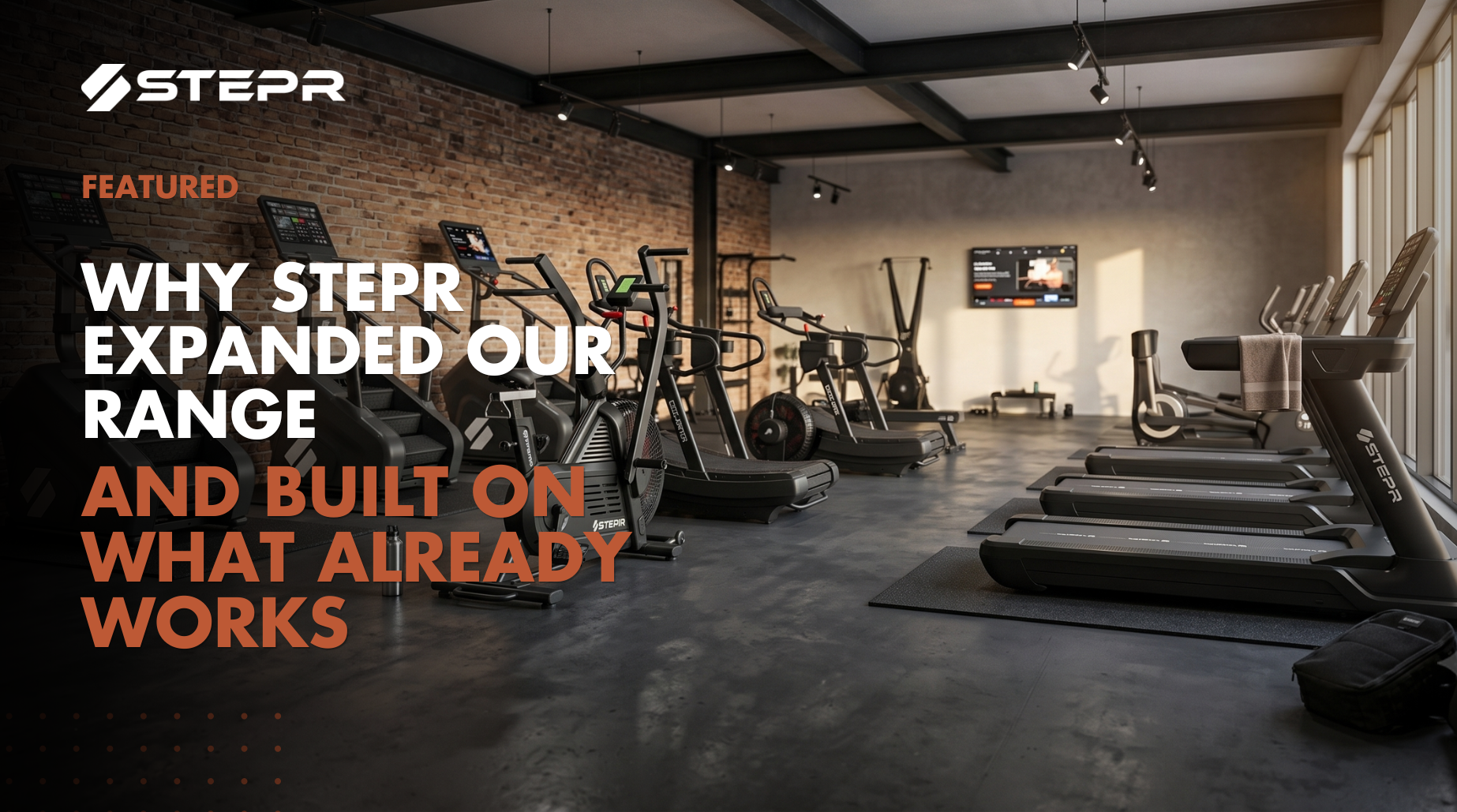
Why STEPR Expanded our Range and Built on What Already Works
STEPR was built on a simple premise: the most effective training modalities already exist. The question was never "what to invent from scratch" it was "how do we bring genuine innovation to what already works". Here is why the range looks the way it does.
Home Cardio Machines: Why Value Beats Price Every Time
Why the Stair Climber Is the Hybrid Athlete's Secret Weapon
STEPR Community Surpasses 500 Million Steps: A Milestone Worth Celebrating
Why the UFL Chose STEPR to Train Its Professional Athletes
The 45-7-6 Stair Climber Workout: What the Science Says

It's Our Anniversary: Celebrating STEPR's Biggest Birthday Yet